
RingRing Journal 01 / Artificial intelligence
70 Years of AI.1956–2026
An idea. A field. A world of possibilities.
Artificial intelligence did not arrive in a single breakthrough. It grew through bold ideas, useful inventions, disappointed expectations and patient research. These are the moments that changed what machines could do and what people expected of them.
_(20897323365).jpg)
Seventy years, not a straight line
Progress is a story of changing methods.
Rules, search, statistics and neural networks have all shaped AI. They often work together. This timeline selects turning points; it is not a list of every contribution. Its seventy-year frame marks the Dartmouth summer of 1956, while recognising that the ideas behind it are older.
- 011956
A field gets a name
An ambition becomes a research programme.
In the summer of 1956, researchers gathered at Dartmouth College to explore how machines might simulate aspects of intelligence. John McCarthy, Marvin Minsky, Nathaniel Rochester and Claude Shannon had set out the agenda in a proposal dated August 31, 1955, already using the term “artificial intelligence”.
Why it mattersDartmouth gave a developing field a shared name and an ambitious agenda. It did not invent every idea behind AI: work on computation, logic and neural models came before it.
Read the evidence [1]

John McCarthy, photographed in 2006, fifty years after Dartmouth.Photo: null0 · CC BY-SA 2.0. Converted to black and white and resized by RingRing. This adaptation is available under CC BY-SA 2.0. - 021957–1958
Learning from examples
What if the machine could learn the rule?
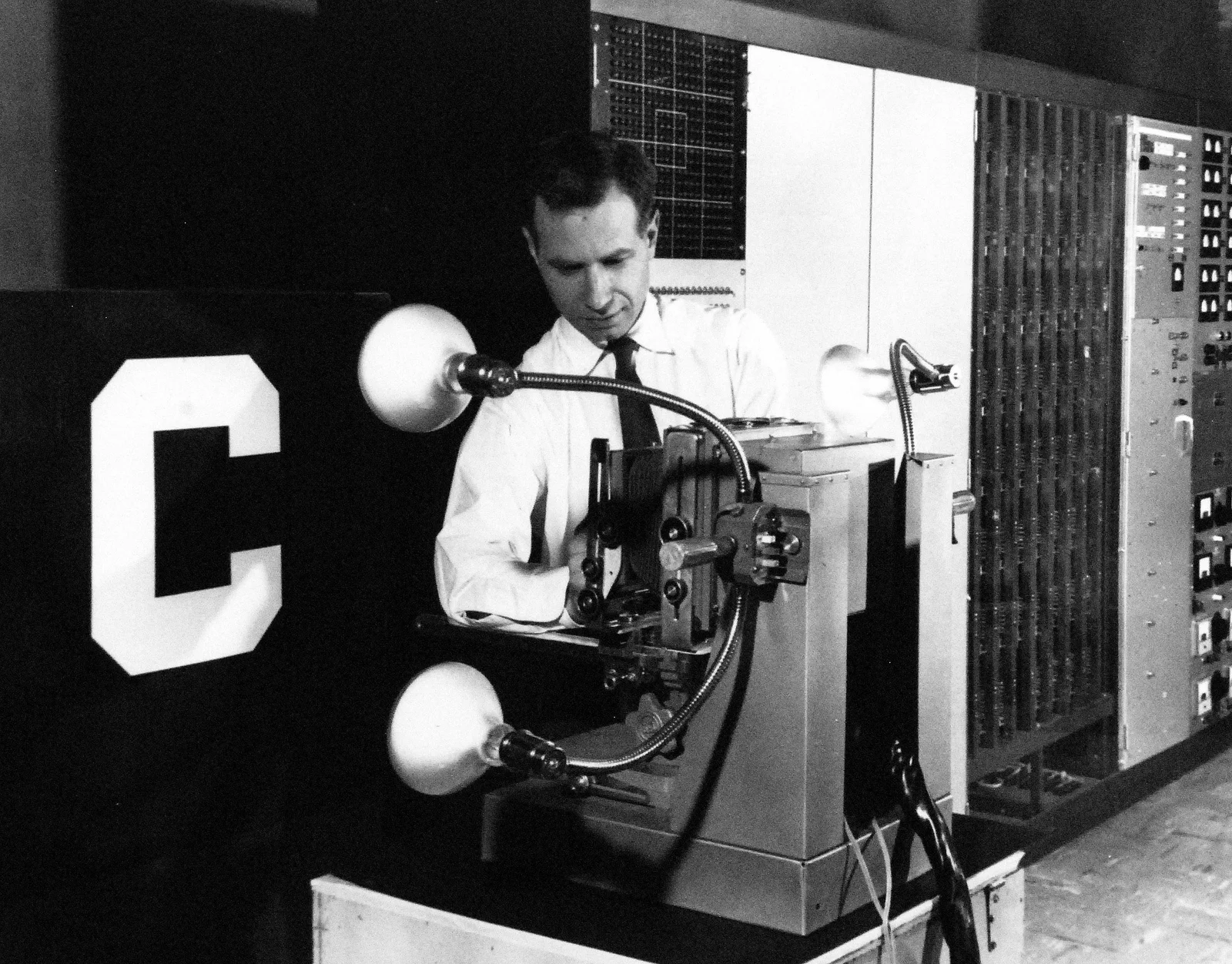
Frank Rosenblatt developed the perceptron, an early neural learning model. A public demonstration in July 1958 used an IBM 704 to learn a simple visual distinction from examples; the physical Mark I Perceptron followed. Instead of specifying every decision by hand, researchers could adjust the strengths of connections through training.
Why it mattersThis was an important route toward machine learning, not a complete model of the brain. A single-layer perceptron has strict limits on the patterns it can separate.
Read the evidence [2]
The Mark I Perceptron. U.S. Navy photograph released June 24, 1960; digitised in 2015.Photo: National Museum of the U.S. Navy · USN 710739 · Public domain (U.S. federal government work). Converted to black and white and resized by RingRing. - 031966
The conversational illusion
A machine can sound as if it understands.
Joseph Weizenbaum’s ELIZA paper described a program that transformed typed input using rules. Its famous DOCTOR script imitated a Rogerian psychotherapist, often turning a user’s words into a question. The effect could feel personal, despite the simple mechanism underneath.
Why it mattersELIZA exposed a gap that still matters: convincing conversation can encourage people to attribute understanding to a system. Fluency alone is weak evidence of intelligence.
Read the evidence [3]
- 041970s
The first winter
Promises meet the limits of the laboratory.
Early systems struggled when problems grew beyond carefully controlled demonstrations. The 1973 Lighthill report criticised AI research in the UK and contributed to cuts in support. Funding and enthusiasm also weakened elsewhere, although the timing and causes differed between countries and research areas.
Why it mattersAn “AI winter” describes a loss of confidence and support, not a worldwide halt in research. The lesson was to judge systems by what they could reliably do beyond a demo.
Read the evidence [4]
- 051970s–1980s
Knowledge becomes software
Useful expertise, one rule at a time.
Expert systems encoded specialised knowledge as rules and used inference to reach conclusions. Projects such as MYCIN explored medical advice, while R1/XCON helped configure computer orders at Digital Equipment Corporation. The ambition narrowed from general intelligence to valuable, bounded tasks.
Why it mattersAI found commercial uses. But acquiring, maintaining and reconciling large rule sets was difficult, and systems were often brittle outside the situations their experts had anticipated.
- 06Late 1980s–1990s
The second winter
Commercial enthusiasm cools. Research continues.
The expert systems boom lost momentum, and the market for specialised Lisp machines contracted. Expensive deployment, maintenance burdens and unmet expectations weakened confidence. Meanwhile, statistical methods, probabilistic reasoning and neural network research continued to develop.
Why it mattersAI’s history is not a clean succession of replacements. Learning systems and symbolic approaches coexisted, and important work survived the retreat of the AI label.
Read the evidence [6]
- 071997
A very specific victory
The world chess champion loses the match.
On May 11, IBM’s Deep Blue completed a 3½–2½ match victory over reigning world chess champion Garry Kasparov. Its strength came from specialised hardware, extensive search and carefully engineered chess evaluation.
Why it mattersA machine could surpass an exceptional human in a prestigious intellectual task. Deep Blue’s victory did not demonstrate general intelligence or human-like understanding.
Read the evidence [7]
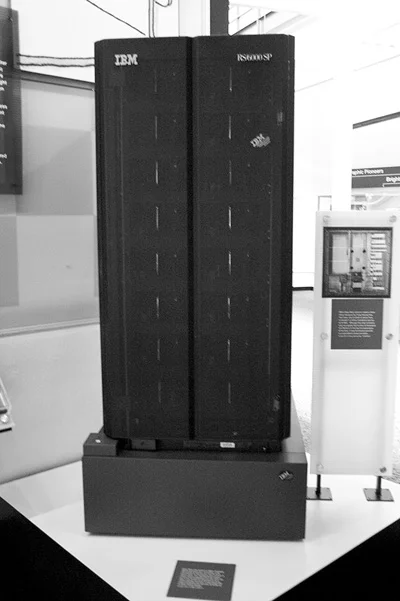
Deep Blue hardware at the Computer History Museum, photographed in 2007. Not a photograph of the match.Photo: James the photographer · CC BY 2.0. Converted to black and white and resized by RingRing. - 082012
The deep learning breakthrough
Data, GPUs and neural networks converge.
Alex Krizhevsky, Ilya Sutskever and Geoffrey Hinton’s deep convolutional network achieved a decisive win in the ImageNet Large Scale Visual Recognition Challenge. The competition’s top-five error fell to about 15.3%, against 26.2% for the next-best entry. Large labelled datasets and GPU training made the difference visible.
Why it mattersThe result accelerated a shift toward learning visual features from data. Deep learning was older than 2012; ImageNet supplied a compelling demonstration at scale, not its invention.
Read the evidence [8]
- 092016
Learning meets search
A new way to play an ancient game.
In March, DeepMind’s AlphaGo beat Lee Sedol 4–1 in Seoul. It combined neural networks trained on human games and reinforced through self-play with tree search. This was the original AlphaGo, not the later AlphaGo Zero system that learned without human game examples.
Why it mattersLearning and search together could tackle a game long regarded as a difficult frontier. The achievement widened expectations for AI while remaining a specialised result.
Read the evidence [9]
- 102017
A new architecture
Attention changes how models handle sequences.
The paper Attention Is All You Need introduced the Transformer for machine translation. It used attention mechanisms rather than recurrence or convolution in its core architecture, allowing more parallel computation during training and modelling relationships across a sequence.
Why it mattersThe architecture became a foundation for many language and multimodal models. It was a major design change, not the invention of attention or a guarantee of truthful output.
Read the evidence [10]
- 112020
Scale changes the interface
Examples in a prompt can become instructions.
OpenAI’s GPT-3 paper described a 175-billion-parameter language model tested on many tasks without task-specific weight updates. Instructions and a few examples in the prompt could guide its output: a single pretrained model could be used in several ways.
Why it mattersPrompting became a practical alternative to training a separate model for every task. Performance was uneven, and convincing text could still be factually wrong.
Read the evidence [11]
- 122022
Images from language
A written idea becomes a visual starting point.
Diffusion methods learn to reverse a process of adding noise. Latent diffusion made image synthesis less computationally expensive by working in a compressed representation. Stable Diffusion’s August 22 public release helped bring these techniques to a wider community of developers and creators.
Why it matters2022 was a turning point in access and use, not the birth of diffusion research. Text-to-image tools expanded creative possibilities and intensified questions about training data, consent and authorship.
- 132022
November 30
The conversation becomes the product.
OpenAI released ChatGPT as a public research preview. It combined a conversational interface with a GPT-3.5-era model trained to follow instructions using human feedback. People could ask follow-up questions, revise an answer and experiment without building their own interface.
Why it mattersThe turning point was also social: language models became easier to encounter and use. The launch explicitly acknowledged limitations, including plausible but incorrect answers.
Read the evidence [14]
- 142023–2024
Beyond text
Seeing and hearing enter the conversation.
Multimodal models brought images, audio and text into increasingly connected systems. GPT-4o, announced in May 2024, was one prominent example, designed to process these modalities together. Capabilities and access arrived in stages, rather than all appearing at once.
Why it mattersThe interface moved closer to the way people encounter the world. Recognising an image or responding to speech still does not ensure reliable reasoning about it.
Read the evidence [15]
- 152025–2026
From answers to actions
The next test is whether the work gets done.
Models connected to browsers, software and other tools can attempt multistep tasks. ChatGPT agent’s 2025 launch illustrated that product shift. Stanford’s 2026 AI Index reports substantial progress on computer-use benchmarks, alongside persistent failures and uneven abilities.
Why it mattersTool use makes AI useful in a different way, and makes mistakes consequential. The frontier is reliability: permissions, verifiable results and human oversight matter as much as an impressive answer. Benchmark success is not a promise of dependable autonomy.


2026 / The story is still open
The next chapter
is a human choice.
Seventy years of AI show that capability and consequence grow together. Better models can open new possibilities; they do not decide which possibilities deserve to become real. That work belongs to the people who build, use, question and govern them.
We can remember the breakthroughs without turning them into a prophecy. The future will be shaped by what we choose to make and what we choose to measure.
Leave a small mark on the RingRing Pixel Wall.
Sources & image credits
Historical dates and technical claims are linked below. “Why it matters” expresses RingRing’s editorial interpretation of that evidence. Coverage ends on October 12, 2026; no future milestones are presented as facts. Winter dates are approximate because funding cycles differed across regions.
- The Dartmouth proposal (1955) ↗
- Cornell: Rosenblatt and the perceptron ↗
- Weizenbaum: ELIZA (1966) ↗
- UK Parliament: the Lighthill report and funding cuts ↗
- Computer History Museum: expert systems, oral history ↗
- AAAI: lessons from the expert systems boom and bust (2026) ↗
- IBM: Deep Blue ↗
- Krizhevsky, Sutskever & Hinton: ImageNet (2012) ↗
- Google DeepMind: AlphaGo ↗
- Vaswani et al.: Attention Is All You Need (2017) ↗
- OpenAI: Language models are few-shot learners (2020) ↗
- Rombach et al.: Latent diffusion models (2021/2022) ↗
- Stability AI: the August 2022 release ↗
- OpenAI: Introducing ChatGPT (November 30, 2022) ↗
- OpenAI: Hello GPT-4o (2024) ↗
- OpenAI: Introducing ChatGPT agent (2025) ↗
- Stanford HAI: AI Index 2026, technical performance ↗
Photographs
All three photographs are locally hosted. Their source records, creators, licences and modifications appear beside the images. The cover uses the same public-domain Mark I image as the timeline. The McCarthy adaptation retains its CC BY-SA 2.0 licence; the Deep Blue adaptation retains attribution under CC BY 2.0. No endorsement by the people or institutions pictured is implied.